

Illuminate (Installation)
The Process

As my project partner Olivia and I walked around campus, we came upon this forgotten space in the woods between the Dining Commons and Carroll Hall. There was a pile of rocks just sitting there, and we wondered what it was. On a plaque near it explained that "These stones were gathered from Ensenada, Mexico and the hills of Montecito and placed there as a loving memorial to Lisa Bebout, Carth Weedman, and Alan Voorman, who lost their lives in a car accident while serving Christ through ministering to the poor of Mexico during Potter's Clay in the spring of 1989."

As a student who has been attending Westmont College for over a year, I had never known about this memorial or heard of the people who passed away twenty years ago. Olivia too, was surprised to find this. Seeing how much this memorial lacked the student body's care and attention, we decided that we would create something that would bring a respectful awareness to this existing monument. We hoped to illuminate this space or the area around it so eyes and hearts would be drawn to it. We first cleaned the area around the stones with brooms as well as take out twigs from the cracks.

Searching for appropriate, reflective, and inexpensive material took a few days. However, when we went to Art from Scrap, we found a basket full of around three hundred plastic bottles waiting for us. Inspired by Tara Donovan's process of building artwork through a kind of dialogue that leads to a specific repetitive action (e.g. stacking, bundling, heaping, etc.), we were so excited to have found a large sum of the same material we could work with.

Tara Donovan's expansion on the idea that art can radically complicate the standard notions of value attached to mass-produced objects was fascinating for us, and we thought that the plastic bottles we found were something we could repeatedly stack/build that in the end, it would lose the environmental connotation given to any forms of plastic bottles. The reflective nature of the bottles would also contrast with the earth-toned stones that made up the memorial, which would bring attention to the space. Sadly, during the critique, our class did make the environmental association. Olivia and I think that if we had more bottles to work with and made our installation a larger scale, it could have worked better. And as Professor Nathan commented, if we had installed this in an indoor white space as Donovan usually does with her artwork, it would have done a more successful job in complicating the standard notions of connotations attached to plastic bottles.

Nevertheless, we think the beauty of creating our piece was the process of finding out that our seemingly large sum of three hundred bottles would only pile up to create a much smaller installation. The bottles had completely filled four cardboard boxes, and we had thought it would be more than enough, but we soon wished we had more bottles to work with.

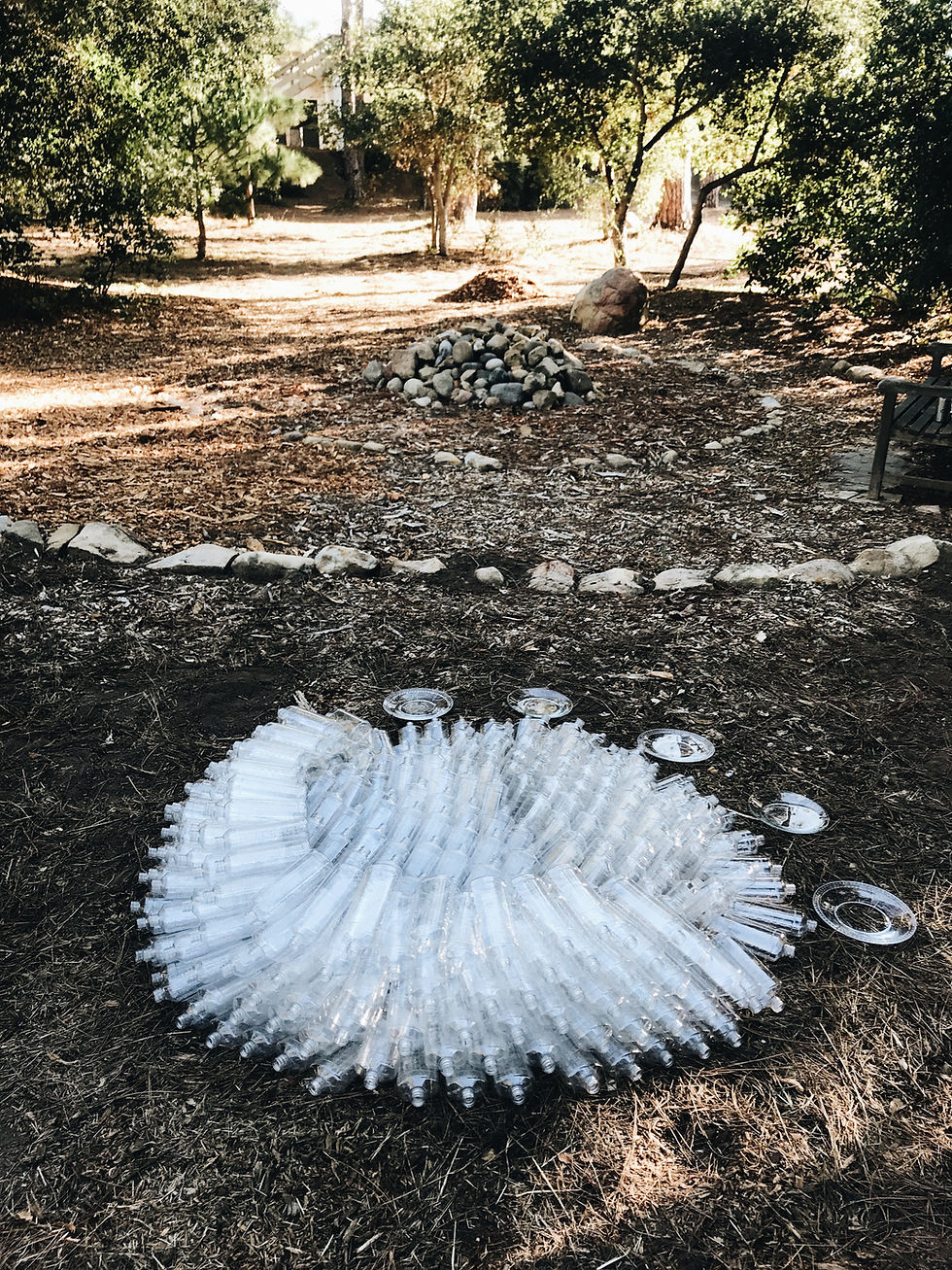
Rather than placing these bottles around the memorial itself (to not dishonor it), we decided to replicate the memorial to the side. We created a circular pattern with the bottles lying flat and close to each other and stacked three more layers on top, with each layer placed a little closer to the middle of the circle. It was going well when one side of the stacked bottles toppled over to create this (image on the left). We found this to be quite a wonderful surprise and proceeded to add more bottles to the middle of the encasement. This shift in the movement of the installation gave it more interesting substance.
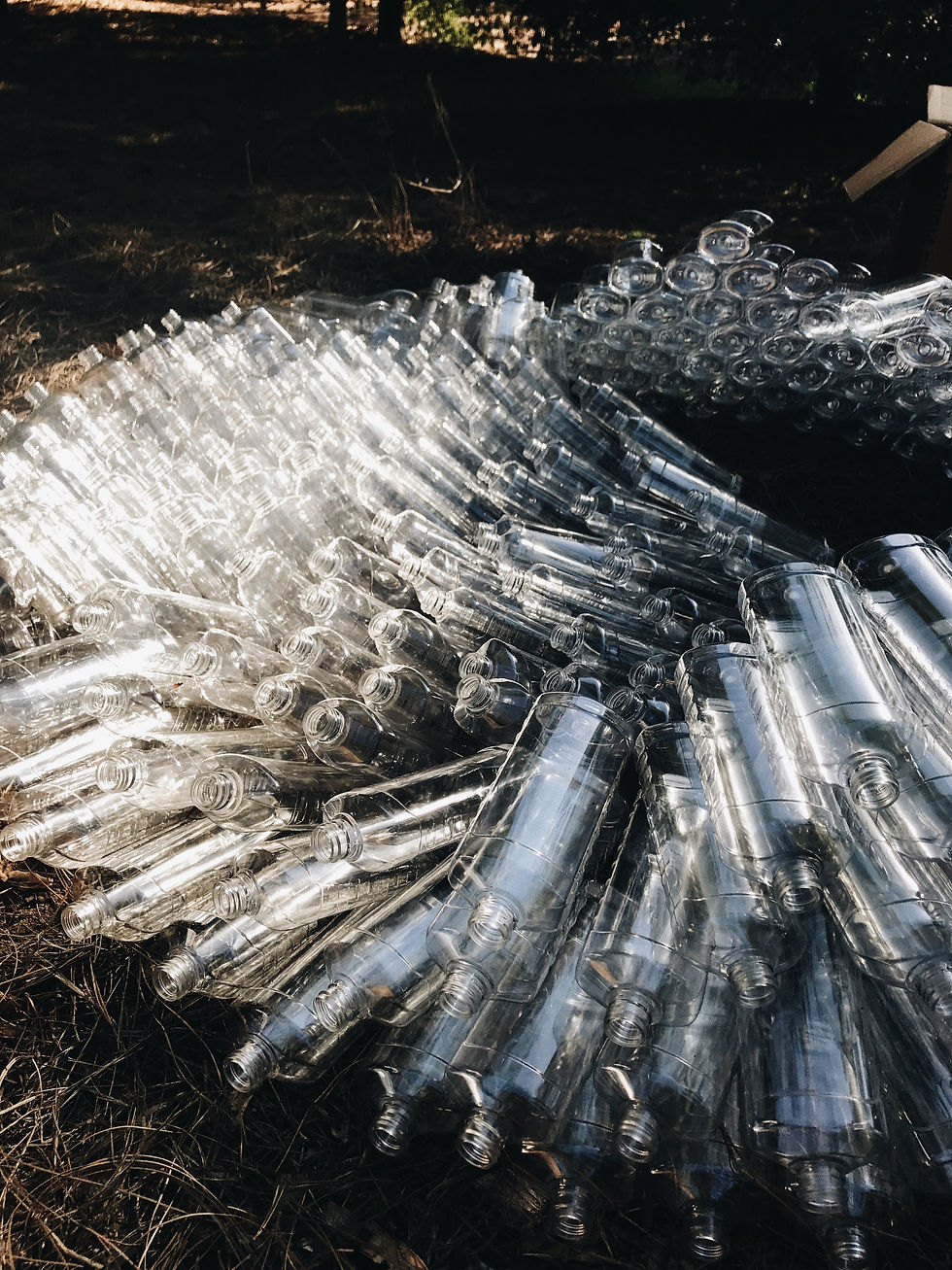
The glow of sunlight reflecting on these bottles made the installation experience more stunning as well (seen in image on the right). As said earlier, we wished we had more plastic bottles, but we worked with what we had. When we were adding finishing touches to the piece, we had to take out some bottles from the outer edges to fill in the inside. Taking out and placing the bottles had to be done meticulously, because the structure could topple over any moment. We thought adding clear glass plates filled with water around it would add more meaning – an outpour of grief or self-reflection – to the piece. So I found some at the thrift store that night and placed them around the installation and filled them with water the very next morning for the critique!
Reflection
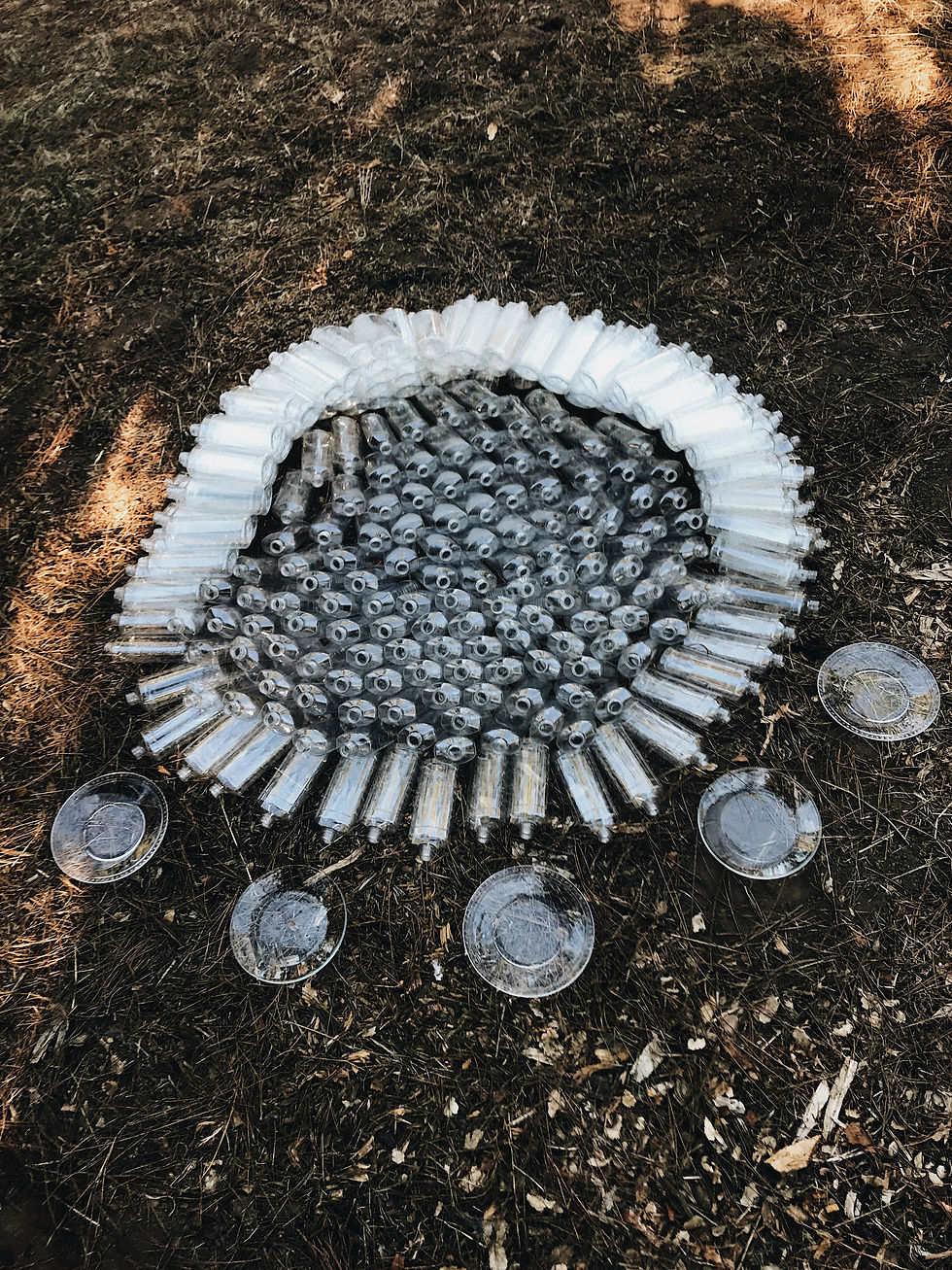
Overall, this piece aimed at illuminating the memorial space by mirroring it with repetitive design. The juxtaposition of the patterned, man-made plastic structure with the nature around it gave the installation a more striking presence yet also the installation and the stone pile's similarity in circular shape created a congruence and dialogue between them. Observing how the approximately three hundred bottles when intentionally placed could only be a minimal length and height made me realize that the pile of rocks were probably made up of countless rocks picked out, brought here, and intentionally placed also. Experiencing the process and product's parallel of our installation and the memorial allowed me to honor the people who passed away in a peaceful, solemn way as well as shed light to the forgotten place it had become. I feel more connected to the memorial in a tranquil, sympathetic way than when I first started.


Comments